


The Importance of Asset Location in Your Portfolio
By Jeff Watson, CFP®
When planning for retirement, most investors focus on what they own - stocks, bonds, cash, and real estate. But equally important is where they own those investments. Asset location is the practice of strategically placing investments across your different account types to maximize after-tax returns. Done well, it can add meaningful value to your portfolio each year without taking on any additional risk.
WHY ACCOUNT TYPE MATTERS
The IRS taxes different types of investment returns in different ways. Understanding that distinction is the foundation of effective asset location. Ordinary income, including most bond interest, short-term capital gains, and distributions from a Traditional IRA, is taxed at your marginal income tax rate. Long-term capital gains, by contrast, receive a lower preferential rate. Both Roth and Traditional retirement accounts offer distinct tax advantages, and the goal of asset location is to match your least tax-efficient investments with the accounts that shelter them most effectively.
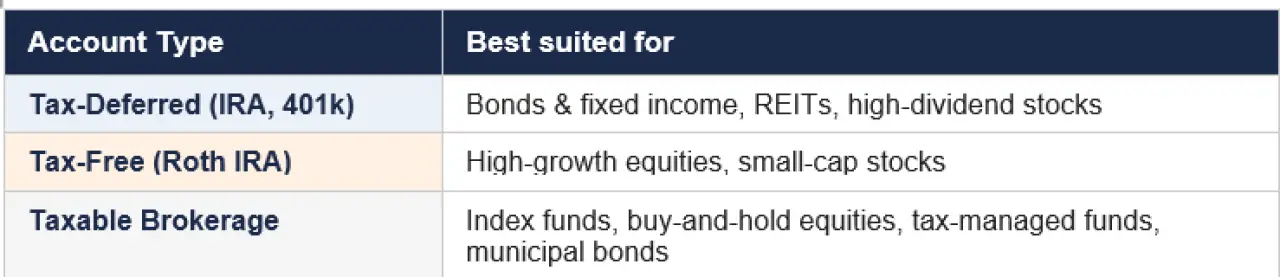
Asset location works best when viewed across your entire household, all accounts considered together as a single coordinated strategy. The right placement for any given investment depends on your tax bracket, account balances, and time horizon, which is why this is not a set-it-and-forget-it decision but an ongoing part of a well-managed financial plan. Like risk tolerance or security selection, asset location is one of the many variables we evaluate when constructing a portfolio, and it can function more like a dial than a fixed setting. The chart below illustrates how different account types interact with different asset classes to maximize after-tax growth.
KEY STRATEGIES IN PRACTICE
Strategically position income-producing assets - Individual bonds, bond funds, and REITs generate regular interest and dividends taxed as ordinary income. Holding these in a tax-deferred account (like a Traditional IRA or 401(k)) means you defer that tax until withdrawal, potentially decades away.
Let growth compound tax-free - Stocks have historically provided the highest long-term returns compared to bonds or cash. Since a Roth IRA is designed for long-term investing, with tax-free growth and withdrawals, an aggressive stock allocation can help maximize compound growth over several decades.
Use your taxable account wisely - Broad index funds and tax-managed equity funds are well-suited to taxable accounts. They produce minimal turnover, and any long-term gains receive preferential tax treatment. You also retain the flexibility to harvest tax losses here to offset gains or use them strategically for tax purposes.
Getting your asset location right requires a clear picture of every account you own, the tax treatment of each, and a coordinated strategy that treats your entire investment portfolio as one unified whole. It is not a one-time decision; it evolves as your accounts grow, tax laws change, and your life circumstances shift. Managing these factors with intention and revisiting them regularly can have a tremendous impact on your overall financial picture and the legacy you ultimately leave behind.