


Sequence of Returns Risk
By Rachel Ryan
Investors are aware of market risk and the expected return of bonds vs equities, but one type of risk, specific to retirees, is sequence of returns risk. That is the risk that poor returns early in retirement, while you are withdrawing money, do more lasting damage than the same returns would later in your retirement. The risk is greatest in the first 5–7 years after retirement. A downturn outside that window tends to work itself out. A downturn inside it can permanently reshape your plan because you are withdrawing money from your portfolio and at the same time it's losing value.
Here's why the timing matters so much. While you're still working, a bad year just means your account is smaller for a while. You are not selling shares to pay bills, so you have time to wait out the recovery. In retirement, you are doing both at once: absorbing the loss and pulling cash out to live on. Every withdrawal during a downturn locks in that loss for good. You have to sell more shares to raise the same amount of cash, and those shares are never there to participate in the market's eventual rebound.
Here is a real-world example:
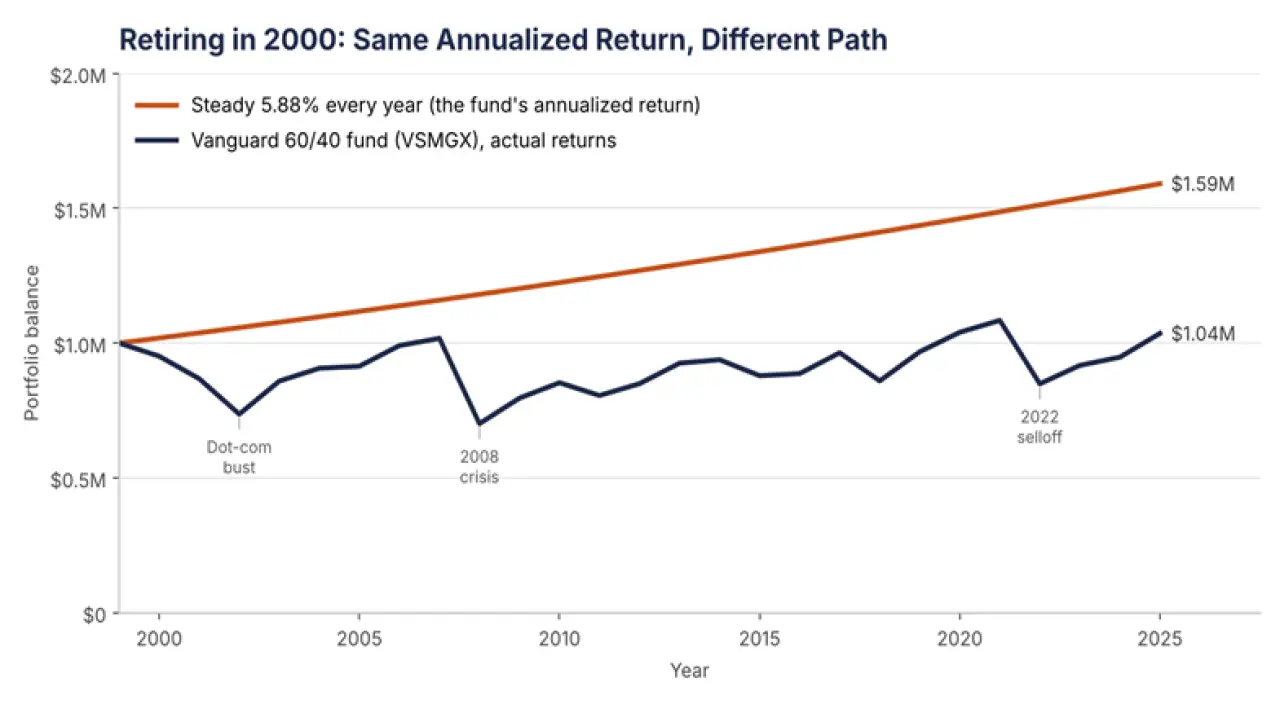
Imagine someone who retired in 2000. They started 2000 with $1,000,000 in retirement savings, allocated in 60% equities and 40% bonds. I will use Vanguard's 60/40 fund (VSMGX) as a reference. The retiree withdrew $40,000 at the end of each year, and that withdrawal increased 2% each year for inflation, that is about $1.35 million in withdrawals through 2025. Their timing was unfortunate. The dot-com bubble burst and the 2008 financial crisis both hit in their first nine years. By the end of 2008, the portfolio had fallen to about $701,000 while the withdrawals kept going. By the end of 2025, it had worked its way back to about $1.04 million.
Now compare that to a steady 5.88% every year. That's the fund's actual annualized return over the same 26 years, also called the geometric mean. With the same withdrawals, the steady portfolio ends at about $1.59 million. Without withdrawals, both portfolios end at the same $4.42 million. Add withdrawals, and the 2000 retiree ends up $555,000 behind. Same fund, same total growth, the only difference is that the bad years came early, while money was going out.
Strategies to Manage the Risk: You cannot control what the market does the year you retire. You can control how your plan is built so that timing does not decide the outcome. And that is the approach we take at Rialto. We do not plan around a single projected return. When we build or update your retirement plan, we run it through a Monte Carlo simulation — hundreds of randomized market scenarios, not just one average outcome — to see how it holds up across a wide range of return sequences, including the unlucky ones. From there, we size your cash and bond positions so a down year does not force a decision that derails your well-deserved retirement. You might not realize this, but if you have a 60/40 portfolio and are spending 4% of your portfolio each year, you have about 10 years’ worth of current spending in fixed income.
Another option, more conservative option, would be for someone nearing retirement to keep a cash reserve to cover roughly 1 year’s worth of living expenses (net of Social Security and any pension income). In a down year, you spend from the reserves instead of selling your invested assets. If there is a longer gap to cover, a bond ladder may be a better fit. If you plan to retire before collecting Social Security or any other pension income, we can build a bond ladder that matches the duration of time between retirement and other income. A bond ladder that matures on a schedule gives you a predictable source of cash for several years out, so equity holdings have time to recover before you need to touch them.
Sequence of returns risk is not about predicting the market; it is about making sure the timing of one bad stretch does not derail decades of planning. Reach out to a Rialto advisor if you have any questions.