By Ethan Gilbert, Partner, CFA, CFP®
The biggest news story in markets this quarter was rising interest rates, both short and long-term. The Federal Reserve hiked short-term rates 0.25%. This was the first increase in three years, and it followed 1.75% of cuts. Further out the curve, the 10-year treasury rose 0.9% to 5.3%, the highest level since 2002.
The war with Iran continued to drag on with seemingly no resolution in sight. West Texas Intermediate (WTI) crude steadily increased from $70 to $90 per barrel. Artificial Intelligence companies came under increased scrutiny from fears around the existential threat of AI. From politicians to CEOs, there is increasing rhetoric for a more measured adoption of the technology. The stock market will continue to try and discern what that means for corporate profits.
Price Action
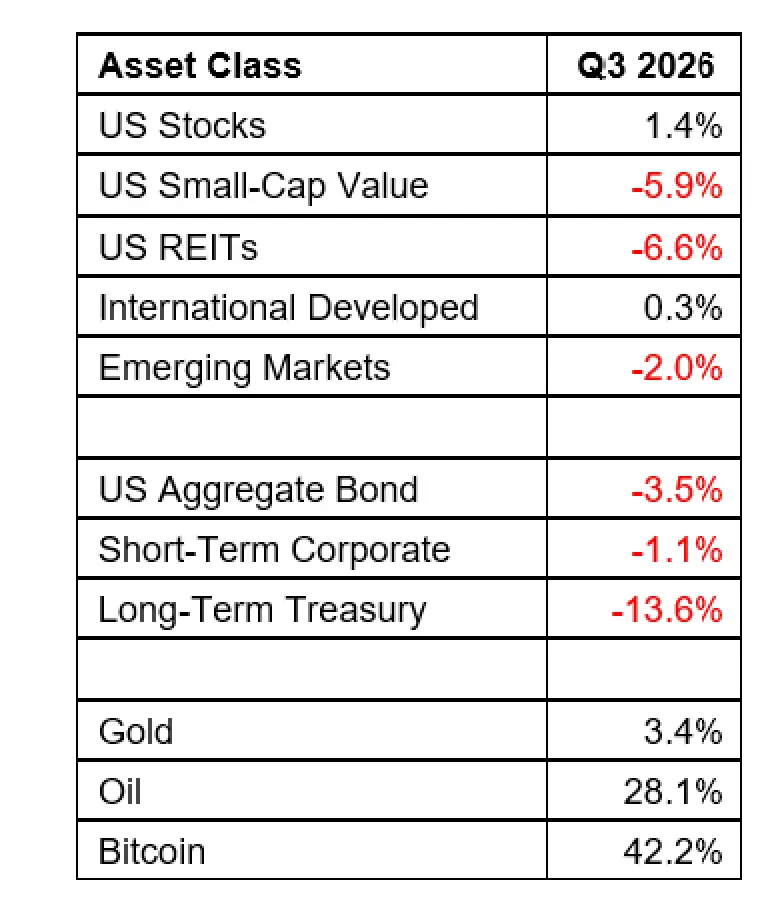
Stocks were flat for the quarter, with US stocks gaining 1.4% and international stocks down 0.4%.
Within domestic stocks, energy companies did the best, gaining 17% on the back of oil’s rise. Meanwhile utilities (-12%), industrials (-9%), and REITs (-7%), all suffered, with utilities and REITs being the most sensitive to interest rates / financing costs.
The technology sector was broadly strong, up 7%, but saw divergence among subsectors. Software companies like Microsoft (+38%), Palantir (+60%), and Salesforce (+47%) shined while AI hardware companies like Micron (-8%), Lam Research (-24%), and Broadcom (-7%) declined.
Small-cap value stocks hold relatively more debt than large-caps, which makes them more sensitive to rising interest rates and borrowing costs, helping to explain their decline (-6%). Interestingly, among international stocks, small value was a top performer (+7%).
Commodities and stores of value did well in Q3, with cryptocurrencies as the biggest winner.
The Fed’s preferred measure of inflation, Core PCE, is running at 3% for the last 12 months. This is an improvement from 3.4% a quarter ago, but still above the Fed’s target. The much-followed CPI is at 3.4%. CPI related figures drive Social Security cost of living adjustments, next year’s tax brackets, and so forth.
Bonds suffered with rising interest rates as the broader bond market, measured by the US Aggregate bond index, declined 3.5%. Long-dated treasuries fared worse, falling 14% in Q3. Municipal bonds had a bit of a rout, falling 5.6% as spreads unexpectedly widened over treasuries. That move was perplexing as state and local finances look fundamentally stronger than federal.
Home prices gained 1.2% for the last three months we have data. It will be challenging to maintain that momentum with rising mortgage rates, which are now at 7.3%, up from 6.4% three months ago.
Looking Forward
The main market drivers in the coming months will be war in the Middle East, the Federal Reserve, and corporate earnings... if that sounds familiar, it should.
Any outcome with Iran that leads to a reliable supply of oil exports will be positively viewed by markets.
Futures markets are pricing in three more rate hikes by the Federal Reserve in the next 9 months. Predicting whether that happens is hard; predicting how stocks and bonds will react may be even harder.
Lastly, S&P 500 earnings are on pace to grow 32% in 2026. Analysts are forecasting 15% in 2027, and 17% in 2028. These are incredible numbers considering the long-term average is 6%. If companies can hit those numbers in the coming years, expect strong returns. If we revert to historical averages, we could be in for a rough stretch, at least among large-cap U.S. stocks.